American Income Life: Cash Surrender Value
***
For fillable Forms and training materials visit this link
Relevant Background: Policyholders can withdraw money (cash surrender value) from their whole life policies to pay for obligations such as tax owing, property tax, credit card payments, unforeseen events etc.
***
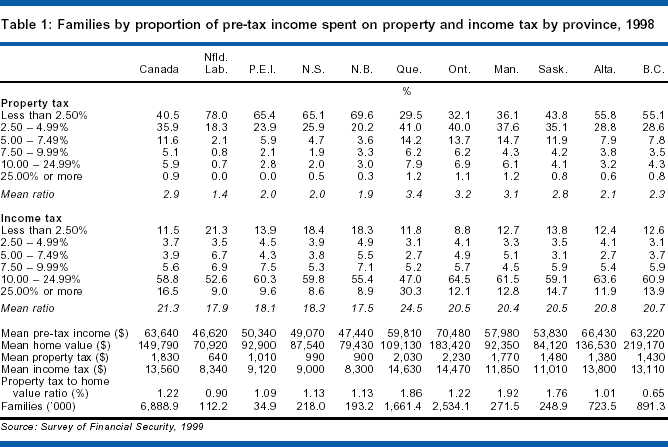
Relevant Material: "Homeowners pay property tax directly to their local government whereas renters pay through their rent. The tax due is typically calculated by multiplying the assessed value of the property by the tax rate—commonly referred to as 'mill rate' and expressed as dollars of tax per $1,000 of assessed value. Residential properties are usually taxed at lower rates than non-residential properties.  3 For example, in Ontario the residential rate is 85% of the non-residential rate (Slack 2000; OFTS 1993). Property tax is one of the three main taxes paid by households. The other two are income tax and sales tax. Property tax differs in that it is a tax on an asset rather than a financial flow. Property tax is levied on the full value of the property, not the owner's equity....In 1998, the average homeowner paid $1,830 in property taxes (Table 1), ranging from $640 in Newfoundland and Labrador to $2,230 in Ontario. Quebec was the only other province higher than the Canadian average, at $2,030. In general, property taxes were lower in the Atlantic provinces and higher in Ontario and Quebec, with the Western provinces in the middle...Property taxes are based on two factors: assessed value and mill rate. The assessed value was not available, but homeowners did estimate the current value of their homes. According to these estimates, average property values were highest in British Columbia ($219,000) and Ontario ($183,000), followed by Alberta ($137,000) and Quebec ($109,000). In the remainder of the country, the average home was valued between $71,000 and $92,000....Dividing the property tax by the estimated property value yields an estimate of the effective property tax rate. Using this approximation, homeowners in Quebec, Manitoba and Saskatchewan were the most heavily taxed in 1998—1.8% to 1.9% of the estimated property value. At the opposite end of the scale, British Columbian homeowners paid just 0.7%. The effective property tax rates of other provinces were in a tight band between 0.9% (Newfoundland and Labrador) and 1.2% (Ontario)..." (Chawla and Wannell, 2004).
3 For example, in Ontario the residential rate is 85% of the non-residential rate (Slack 2000; OFTS 1993). Property tax is one of the three main taxes paid by households. The other two are income tax and sales tax. Property tax differs in that it is a tax on an asset rather than a financial flow. Property tax is levied on the full value of the property, not the owner's equity....In 1998, the average homeowner paid $1,830 in property taxes (Table 1), ranging from $640 in Newfoundland and Labrador to $2,230 in Ontario. Quebec was the only other province higher than the Canadian average, at $2,030. In general, property taxes were lower in the Atlantic provinces and higher in Ontario and Quebec, with the Western provinces in the middle...Property taxes are based on two factors: assessed value and mill rate. The assessed value was not available, but homeowners did estimate the current value of their homes. According to these estimates, average property values were highest in British Columbia ($219,000) and Ontario ($183,000), followed by Alberta ($137,000) and Quebec ($109,000). In the remainder of the country, the average home was valued between $71,000 and $92,000....Dividing the property tax by the estimated property value yields an estimate of the effective property tax rate. Using this approximation, homeowners in Quebec, Manitoba and Saskatchewan were the most heavily taxed in 1998—1.8% to 1.9% of the estimated property value. At the opposite end of the scale, British Columbian homeowners paid just 0.7%. The effective property tax rates of other provinces were in a tight band between 0.9% (Newfoundland and Labrador) and 1.2% (Ontario)..." (Chawla and Wannell, 2004).1. Chawla, K. Raj and Wannell Ted, (2004). Property Taxes. Perspectives on Labour and Income The Online Edition, 4(7), https://www150.statcan.gc.ca/n1/pub/75-001-x/00703/6578-eng.html
**
- Relevant Resources:
- Blog: https://jotformk.wixsite.com/ncyclopedia Hand Made Products Shop: https://www.etsy.com/ca/shop/Tekksavvy Blogger: https://www.blogger.com/profile/07524401563605547321 Shopify shop: https://tekks-shop.myshopify.com Ebay: ebay.io/m/eihOrP Ringtones: https://www.zedge.net/profiles/357e11a5-25fb-4415-9a6a-7da2239c2aba/ringtones Beats: https://airbit.com/share/Tekksavvy/bull-market-mp3 Excel Templates & Calculators: https://youtu.be/-8XdrnnlNuETax Calculators: https://youtu.be/bzq9D0fccqESkype ID: ptlb0142_1Stock Broker Referral Link:https://portal.ingotbrokers.com/en/accounts/open-account/agent?k=cruiseFreelancer Referral Link: https://www.freelancer.com/get/ptlb0142?f=giveSkip The Dishes Courier: Referral Code: 6S69IHUber Eats Driver: Referral: ubaidp147ueInstacart Shopper - Referral Code: TSAVVY9010DLending Loop: https://auth.lendingloop.ca/
StarLink Referral Link (Get One Month of Free Service): Link- Referral Code: Hey! Join me on Wealth simple and get $25 when you fund any account with my referral link: wealthsimple.com/invite/LLV6BG
Referral Link (Coinbase): Hey! Join me on Coinbase and receive $30 (CAD) in BTC for the first trade over $30 with my referral link (https://coinbase.com/join/
Referral Link (CIBC):
Refer and earn cash: Refer a friend and you’ll both earn $50† Refer up to 50 friends each calendar year. Qualifying actions apply†https://www.cibconline.cibc.com/ebm-resources/public/cibc-referral-app/client/index.html#/welcome?locale=en&xref=11117111615209656632&utrc=E2358:1


Comments
Post a Comment